Pesto is Genoa’s gift to the world. Today you find it in supermarkets from Tokyo to New York, but its story begins in the kitchens of a seafaring city, with a marble mortar, a wooden pestle and a handful of very fragrant basil.
The name: to pound
“Pesto” comes from the Genoese verb pestâ, meaning to pound or crush. The name describes the method, not the ingredients: pesto is anything crushed in a mortar. That is why, for the Genoese, the mortar is not a detail. Crushing the leaves, instead of chopping them with a blade, releases the aroma of the basil without heating it.
Ancient ancestors
Romans already ate moretum, a paste of garlic, cheese, herbs, olive oil and vinegar, crushed together. In medieval Genoa, cooks prepared agliata, a sauce of garlic and walnuts. Garlic was a basic food for Ligurian people and especially for sailors.
When basil arrived
Basil is the heart of modern pesto, but it appears in written recipes surprisingly late: it is documented only from the 1850s. In 1852 Emanuele Rossi published La Vera Cuciniera Genovese, and in 1863 Giovanni Battista Ratto’s La Cuciniera Genovese described a sauce made with garlic, basil (or marjoram and parsley when basil was not available), grated cheese, pine nuts, a little butter and oil, all crushed in a mortar.
One detail is telling: Ratto recommended Dutch cheese. Genoa was a trading port, and products from Northern Europe were part of everyday cooking. Today the traditional recipe uses Parmigiano Reggiano and Pecorino, often Pecorino Sardo.
Pesto conquers the world
Pesto travelled with Ligurian emigrants. Early American recipes appeared in the 20th century, and from the 1980s it became popular across North America and then everywhere. In Genoa the sauce is so important that there is a World Pesto Championship, where competitors from many countries make pesto in the mortar, and there have been proposals to have it recognised by UNESCO as intangible cultural heritage.
The traditional ingredients
A classic pesto alla genovese is made with:
- young, small-leaved Genoese basil
- extra virgin olive oil, ideally Ligurian and delicate
- garlic
- pine nuts
- Parmigiano Reggiano and Pecorino
- coarse salt, which helps to crush the leaves
The secret is in the order and the gesture: garlic and salt first, then the basil crushed with a rotating movement, then pine nuts, cheese and finally oil, poured slowly.
How Genoese eat pesto
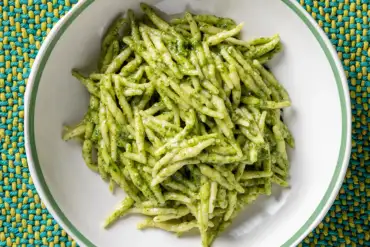
In Genoa pesto goes with trofie, short twisted pasta from the Riviera, with trenette, often cooked together with green beans and potatoes, and in lasagna with pesto, made with thin sheets of pasta. A spoonful also goes into minestrone alla genovese.
Make it with us in Genoa
There is no better souvenir than learning to make pesto in the city where it was born. In our pesto and trofie class you crush basil in a marble mortar, shape fresh trofie by hand and then sit down to eat them. You can also choose lasagna with pesto as one of your three recipes.
Want to know more about the city behind the sauce? Read how Genoa’s history ended up on the plate, and the surprising story of blue jeans, born in Genoa.